
Coastal Carolina Riverwatch + University of North Carolina Wilmington
NC SAV Watchers
Community Science for Healthy Underwater Habitats
What can submerged aquatic vegetation tell us about the health of coastal North Carolina?
Coastal Carolina Riverwatch (CCRW) is partnering with the University of North Carolina Wilmington (UNCW) to help answer that question through NC SAV Watchers, a research and community-science initiative designed to expand monitoring of submerged aquatic vegetation, or SAV, and the water conditions that influence these important underwater habitats.
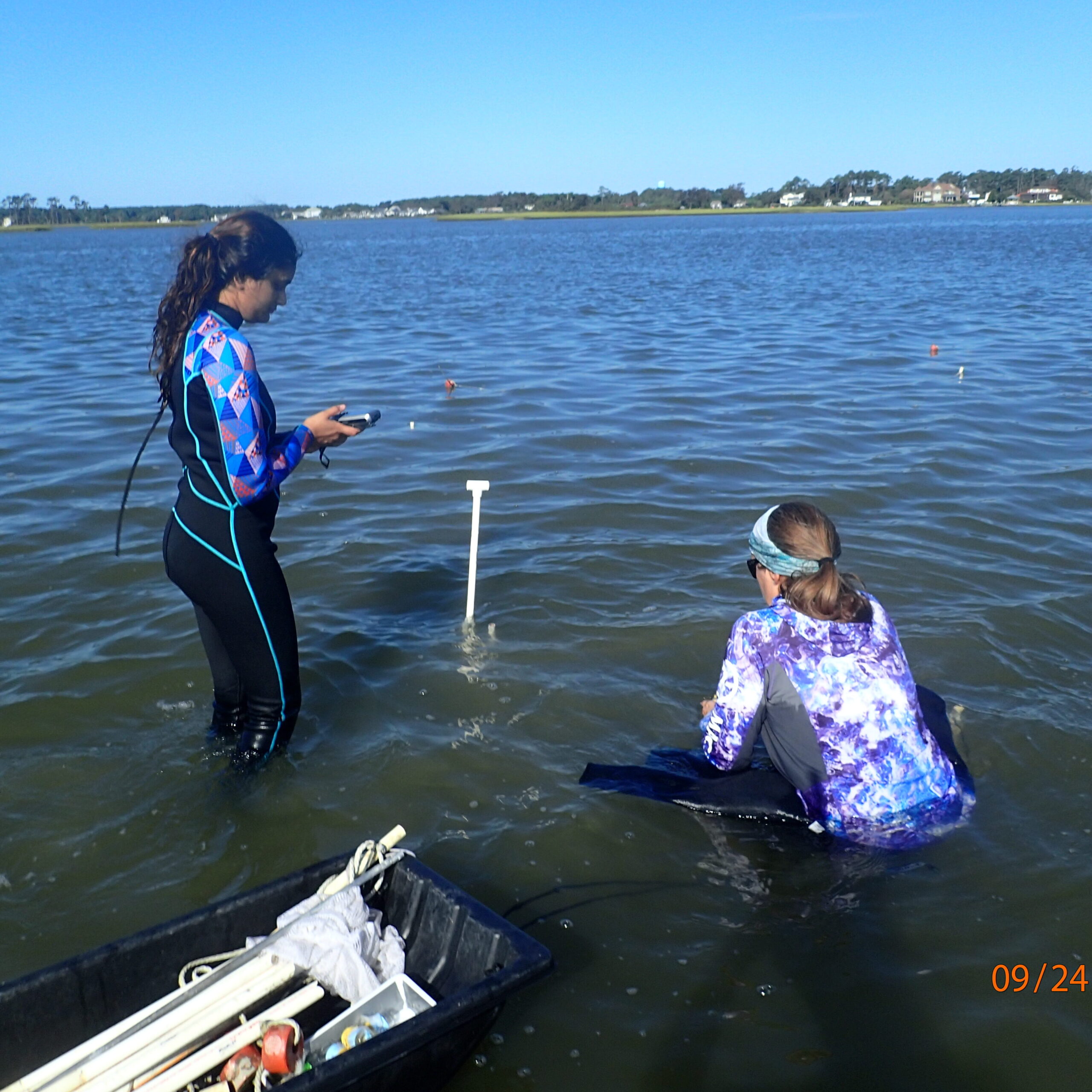
Photo featured by North Carolina Sea Grant with the NC SAV Watchers research project.
NC SAV Watchers is part of the research project formally titled “Evaluating the Accuracy, Precision, and Reliability of Citizen Science Data for Ecological Metrics in North Carolina Coastal Habitats.” The project is supported through North Carolina Sea Grant’s 2026–2028 Core Research Program.
The research is led by Dr. Jessie C. Jarvis of UNCW, with Lisa Rider of Coastal Carolina Riverwatch serving as Co-Principal Investigator. White Oak Waterkeeper Christina Boxberger leads CCRW’s community implementation, volunteer coordination, and field activities.
The White Oak River Basin is serving as an important community implementation area for the project, with initial Fall 2026 SAV fieldwork focused in Chadwick Bay near Sneads Ferry. What the research team learns through these early monitoring efforts will help inform the development of a practical NC SAV Watchers model that can be refined and potentially expanded to other coastal communities.
NC SAV Watchers at a Glance
Two-year research and community-science initiative supported through North Carolina Sea Grant.
Dr. Jessie C. Jarvis and the University of North Carolina Wilmington.
Coastal Carolina Riverwatch coordinates community participation and local implementation.
White Oak River Basin, with Fall 2026 monitoring focused in Chadwick Bay near Sneads Ferry.
What is SAV?
Submerged aquatic vegetation, or SAV, refers to aquatic plants that grow completely underwater.
In coastal areas, some types of SAV are commonly called underwater grasses or seagrasses.
Although these habitats can be difficult to see from shore, they are an important part of healthy coastal ecosystems.
SAV meadows can:
- Provide nursery and refuge habitat for fish, shellfish and other aquatic organisms
- Stabilize bottom sediments and help reduce erosion
- Slow water movement and reduce wave energy
- Support nutrient cycling and other ecological processes
- Help maintain clearer water by stabilizing sediments
- Support productive, diverse and resilient estuarine ecosystems
Peer-reviewed research describes seagrass meadows as ecosystem engineers that can influence sediment movement, water clarity, biodiversity, fisheries habitat, carbon storage and coastal resilience. Because these underwater plants depend on adequate light and suitable environmental conditions, changes in SAV can also provide important information about changes occurring in the surrounding estuary.
Why Monitor SAV Now?
A 2026 analysis from the Albemarle-Pamlico National Estuary Partnership documented a substantial decline in North Carolina’s high-salinity seagrass habitat.
The decline was not uniform across the coast, reinforcing the need for monitoring at both broad and local scales. Long-term aerial mapping remains essential, but field observations can help researchers understand habitat conditions at places and scales that may be difficult to capture from imagery alone.
Read the 2026 North Carolina update on seagrass habitat decline.
Building NC SAV Watchers
The larger research project has an important question at its center:
To answer that question, the project is doing more than simply recruiting volunteers to collect observations. Researchers are intentionally comparing community-generated information with professional datasets so they can evaluate where community monitoring performs well, where uncertainty occurs and what training or quality-assurance measures are most useful.
Across the broader two-year research effort, the NC Sea Grant project calls for monthly water-quality monitoring and biannual SAV surveys, with researchers collecting parallel datasets for comparison.
The Fall 2026 Chadwick Bay field event is an early pilot within that larger effort and uses a simplified set of field observations while volunteers and researchers refine training, field procedures and data-submission tools.
Train
Community scientists learn about SAV, field methods, identification, water clarity, safety and data submission.
Observe
Participants use coordinated protocols to document SAV, habitat conditions, location, water conditions and photographs.
Compare
UNCW researchers collect professional observations that can be compared with community-generated data.
Refine
The team evaluates accuracy, consistency and volunteer experience, then improves protocols and training for future monitoring.
The long-term goal is not simply to conduct individual volunteer events. The research is testing whether a practical and scientifically useful community-monitoring model can help increase SAV monitoring capacity in coastal North Carolina.
Read North Carolina Sea Grant’s description of the NC SAV Watchers research project.
What the Science Tells Us
NC SAV Watchers is grounded in a larger body of scientific research on seagrass ecology, water quality and community-based environmental monitoring. Several findings are especially relevant to this project.
SAV supports multiple ecosystem services
Peer-reviewed reviews document the importance of seagrass for biodiversity and nursery habitat, nutrient cycling, sediment stabilization, carbon storage, water quality and coastal protection.
Light and sediment matter
Fine sediment can affect seagrasses by reducing underwater light, settling on plant surfaces, burying plants and changing conditions within the sediment around their roots and rhizomes.
Read the 2021 global review in Marine Environmental Research
Community-science design affects data quality
Research on volunteer biological monitoring shows that protocol design, training, validation and project structure can influence the quality and usefulness of community-generated data.
There is a tested SAV community-science model
The Chesapeake Bay SAV Watchers program was developed through a collaborative process involving scientists, monitoring coordinators and volunteers, providing an important foundation for North Carolina’s work.
Learning From Chesapeake Bay SAV Watchers
North Carolina is not starting from scratch. NC SAV Watchers draws lessons and resources from the established Chesapeake Bay SAV Watchers Program.
Chesapeake Bay SAV Watchers is the volunteer-based Tier II component of the Chesapeake Bay Program’s larger SAV monitoring system. Trained volunteers document SAV diversity and habitat characteristics and submit field observations and photographs. Their work is designed to complement, rather than replace, broader aerial surveys and more intensive professional monitoring.
The Chesapeake program also demonstrates the value of tiered participation, standardized training, clear field protocols, strong photographic documentation and digital data submission. NC SAV Watchers is adapting lessons from that model to North Carolina’s coastal habitats, research questions and communities.
Explore Chesapeake Bay SAV Watchers and its volunteer monitoring resources.
Our Partnership With UNCW
The research is led by Dr. Jessie C. Jarvis, Professor in UNCW’s Department of Biology and Marine Biology and Principal Investigator of the Coastal Plant Ecology Lab.
Dr. Jarvis’s research focuses on the ecology of estuarine and coastal shallow-water habitats vegetated with seagrasses and other submerged aquatic vegetation. Her work examines relationships between aquatic plants and environmental factors, including water-quality conditions that influence growth, reproduction, survival, resilience and restoration. Her research interests also include remote sensing, ecological modeling and water-quality monitoring.
For NC SAV Watchers, UNCW provides scientific leadership, professional monitoring and research design. Coastal Carolina Riverwatch helps translate that research framework into community implementation by coordinating volunteers, local field logistics, outreach, education and connections with communities in the White Oak River Basin.
Why this partnership matters
Community monitoring is most useful when local knowledge and volunteer participation are paired with a research design that allows the quality of the resulting data to be evaluated.
NC SAV Watchers brings those pieces together.
Learn more about Dr. Jessie Jarvis and her research at UNCW.
Fall 2026 Pilot
Chadwick Bay Community SAV Survey
Friday, October 9, 2026
Chadwick Bay | Sneads Ferry, North Carolina
This fall, CCRW and UNCW will work with a pilot group of trained community volunteers to conduct SAV monitoring in Chadwick Bay.
The survey builds on an August 2026 project field day during which UNCW researchers and CCRW reviewed SAV conditions, potential monitoring locations and field methods in Chadwick Bay and refined the approach for the first community survey.
During the October pilot, volunteers will help document:
- Whether SAV is present or absent
- Presence or absence of selected SAV species or species groups
- Whether SAV appears patchy or continuous
- Water depth
- Water clarity
- GPS location
- Photographs and field observations
For this initial pilot, volunteers will remain in their kayaks or paddle craft rather than entering the water.
Several components of the scientific monitoring protocol have intentionally been simplified for the first community survey so observations can be collected as consistently as possible by trained volunteers.
For safety reasons, participating volunteers must be at least 21 years old and have prior paddling experience. Additional field logistics and safety information are being provided directly to participating volunteers.
Volunteer Training
Thursday, September 24, 2026
5:30 p.m. | Virtual
Before the October field survey, volunteers will learn about SAV ecology, identification, field methods, water clarity, field safety, photo documentation and the digital tools used to record observations.

Image source: Albemarle-Pamlico National Estuary Partnership.
What Will Community Scientists Measure?
The project is intentionally testing methods that are both scientifically meaningful and realistic for trained community members to use consistently.
For the initial Chadwick Bay pilot, volunteers will focus on relatively straightforward observations such as SAV presence or absence, selected species observations, general SAV distribution, water depth and clarity, GPS location and photographs. As the project advances, researchers will evaluate which measurements provide the best combination of scientific value, repeatability and realistic field use.
Photographs are especially valuable because they create a visual record that can be reviewed alongside a submitted observation. Photo documentation can help verify species observations, provide context about habitat conditions and strengthen quality-assurance procedures.
From Field Observation to Research Data
Community observations are being designed for digital submission using ArcGIS Survey123.
The project’s data workflow allows submitted observations, photographs and location information to be reviewed as part of the quality-assurance and quality-control process before information is prepared for broader use.
That review step is important because NC SAV Watchers is not only interested in collecting more observations. The research is specifically evaluating the accuracy, precision and reliability of community-generated ecological data.
Connecting SAV and Water Quality
Healthy underwater vegetation depends on suitable water conditions.
Because SAV must photosynthesize below the water surface, enough sunlight must reach its leaves. Suspended sediment and other sources of turbidity can reduce light penetration. Fine sediments can also settle onto plants or bury portions of them. Nutrient enrichment, algal growth, physical disturbance, storms, temperature changes and other environmental stressors can also influence SAV condition and distribution.
This is why NC SAV Watchers considers SAV observations alongside water conditions rather than treating vegetation and water quality as separate issues.
APNEP’s SAV monitoring program has coordinated long-term efforts to map and monitor underwater grasses and describes SAV as an important indicator of overall estuarine condition.
NC SAV Watchers also connects community participation with educational approaches used by programs such as NC Stream Watch, a North Carolina Department of Environmental Quality program that encourages communities to observe, explore and learn about the state’s waterways.
Why Community Science?
North Carolina has an extensive network of rivers, estuaries, sounds and coastal waters. Professional researchers and resource managers cannot be everywhere at every point in time.
Well-designed community science can increase the geographic reach and frequency of environmental observations while giving residents opportunities to build knowledge and stewardship around the waters they care about.
But useful community science requires more than collecting a large quantity of information. The methods must be understandable, observations must be collected consistently, and researchers need a way to evaluate uncertainty and data quality.
NC SAV Watchers is testing the data as well as the monitoring approach.
By comparing observations from trained community members with professionally collected observations, researchers can determine where community-generated data are dependable, where additional training or quality control may be needed, and how these observations could complement existing monitoring programs.
SAV Monitoring Across North Carolina
The Albemarle-Pamlico National Estuary Partnership and its partners have worked for more than two decades to map and monitor North Carolina’s underwater grasses.
APNEP’s monitoring program combines large-scale mapping with field-based observations to better understand SAV location, extent and change through time. That combination is especially important because SAV can occur in patchy beds and in waters where turbidity or other conditions make aerial detection more difficult.
NC SAV Watchers does not replace those established monitoring programs. Instead, it is testing whether trained community observers can contribute another useful layer of locally collected information.
Explore APNEP’s SAV monitoring program, maps and scientific resources.
From a Local Pilot to a North Carolina Model
Chadwick Bay is an early testing ground, but the larger vision extends beyond one field location. The project team will use what it learns from monitoring events, professional comparisons and participant feedback to refine training materials, field procedures, digital data tools and quality-control methods.
If the approach proves reliable, NC SAV Watchers could help create a more scalable framework for community-supported SAV monitoring in other parts of coastal North Carolina. The goal is a program that is useful to scientists and resource managers while also being understandable, practical and meaningful for the communities participating in it.
Follow NC SAV Watchers
This webpage will serve as a growing home for NC SAV Watchers. As the project develops, CCRW plans to share:
- Updates from community monitoring events
- Photos and stories from the field
- SAV identification and educational resources
- Volunteer training resources
- Maps and monitoring information
- Future volunteer opportunities
- Research updates and project findings
- Information about the UNCW, NC Sea Grant and CCRW partnership
Interested in future NC SAV Watchers opportunities?
Visit CCRW’s Get Involved page to learn more about volunteering with Coastal Carolina Riverwatch.
You can also contact CCRW White Oak Waterkeeper Christina Boxberger at Waterkeeper@coastalcarolinariverwatch.org.
Project Partners & Resources
Coastal Carolina Riverwatch
Community coordination, outreach and implementation within the White Oak River Basin.
University of North Carolina Wilmington
Scientific leadership, professional monitoring and research.
North Carolina Sea Grant
Support through the 2026–2028 Core Research Program.
Albemarle-Pamlico National Estuary Partnership SAV Monitoring
North Carolina SAV monitoring, mapping and scientific resources.
Chesapeake Bay SAV Watchers
Established volunteer SAV monitoring program whose methods and experience help inform the North
Carolina effort.
NC Stream Watch
Community water education and observation resources from the North Carolina Department of Environmental Quality.
Science & Further Reading
Camara Lima, M. do A., et al. (2023).
“A review of seagrass ecosystem services: providing nature-based solutions for a changing world.”
Hydrobiologia, 850, 2655–2670. View publication.
Zabarte-Maeztu, I., et al. (2021).
“Fine sediment effects on seagrasses: A global review, quantitative synthesis and multi-stressor model.”
Marine Environmental Research, 171, 105480. View publication.
Lewandowski, E. & Specht, H. (2015).
“Influence of volunteer and project characteristics on data quality of biological surveys.”
Conservation Biology, 29(3), 713–723. View publication.
Webster, S. E., Landry, J. B., Laumann, K. M., Swanson, S. & Dennison, W. C. (2021).
“Co-creating and evaluating a citizen science program for monitoring submerged aquatic vegetation in Chesapeake Bay.”
Regional Studies in Marine Science, 46, 101906. View publication.
NC SAV Watchers is a developing research and community-science initiative.
Monitoring methods, data tools, volunteer opportunities and project resources will continue to be evaluated and refined as the research progresses.